
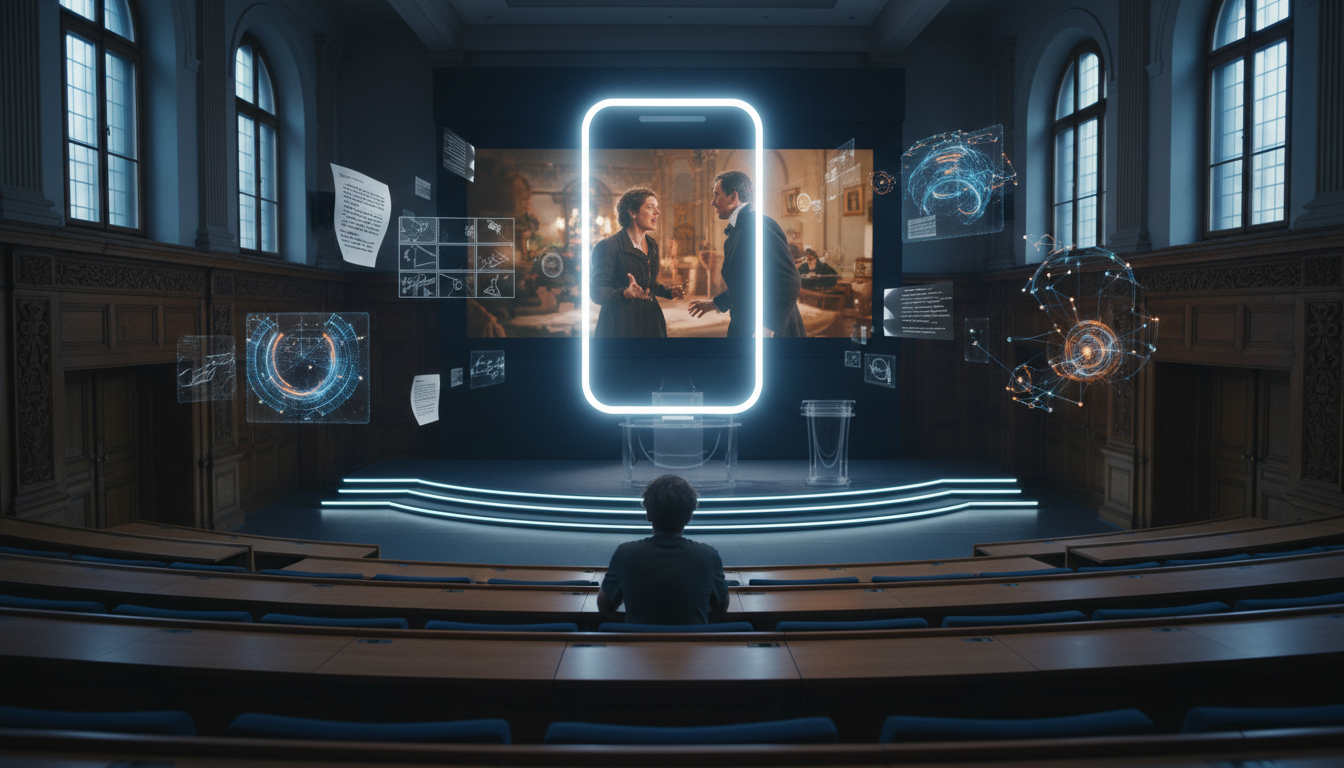
The global micro-drama market is growing to 14 billion US dollars in 2026. China has more than 830 million viewers. In the U.S., Hollywood studios are investing, and TikTok is launching its own micro-drama apps. But who is actually supposed to develop, write, and produce the content for the European market?
Germany has one of the strongest education landscapes for film and television in Europe. But so far, hardly any institution specifically prepares students for the micro-drama format – with its own dramaturgy, its gaming-like monetization, and its radically mobile distribution logic. That is just beginning to change. An overview of the status quo – and the gaps.
The Lighthouse: HFF Munich and the First Master's in Serial Storytelling With AI
The University of Television and Film Munich (HFF München) – one of Germany's most renowned film schools – is sending a strong signal with a new degree program. In the winter semester 2026/2027, the master's program "Serial Storytelling: Created by A.I. & I" will launch – the first of its kind worldwide.
The program was developed by Prof. Taç Romey, who has held the Chair of Serial Storytelling at HFF Munich since 2016. Romey is no ivory-tower theorist: as a writer, showrunner, and producer, he developed, among other things, the award-winning Amazon series "Der Lack ist ab" – Germany's most successful web series. He runs Phantomfilm GmbH in Munich and Amsterdam and is one of the first in the German-speaking world to offer AI workshops for screenwriters and producers.
What the Program Teaches
The master's trains showrunners, head writers, executive producers, content developers, and specialists in AI-supported media production. What makes it special: AI is integrated on three levels:
- As a critical subject of study – engaging with technological, ethical, and legal implications.
- As a creative tool – text, image, and video generation with ethical reflection.
- As a production instrument – integration into real workflows of serial content production.
Prof. Romey formulates the vision like this: "The future of storytelling does not lie in machines writing stories, but in creative minds learning to use AI as an intelligent sparring partner. Our master's program prepares a new generation of serial creatives to responsibly master this powerful tool of media history."
Why This Is Relevant to Micro Drama
Even though the program does not explicitly include "micro drama" in its title, it addresses exactly the skills the format requires: serial storytelling under extreme format constraints, data-driven story optimization, AI-supported production, and an understanding of new distribution logics. Romey himself has published a micro-drama guide as well as the book "Why They Stop Watching" – on developing characters that a young audience can't let go of. Topics that feed directly into the challenges of the micro-drama format.
Applications for the new program have been open since December 1, 2025.
Romey's Publications as a Resource
In addition to the program, Prof. Romey has done important groundwork with his publications:
- "Micro Drama Guide" – a guide that uses photos and scenes to show how composition, perspective, and the distribution of information create suspense in micro dramas.
- "Why They Stop Watching" – on developing characters for a young, mobile audience.
- "Almost Crashed – The Checklist for the Pilot" – a practical checklist for pilot development.
These works are among the few German-language specialist publications that deal specifically with the dramaturgy of short, serialized formats.
The German Film Schools: Strong Foundation, but Hardly Any Micro-Drama Focus
Germany has an excellent network of film schools:
- HFF München – with the new master's program, the clear pioneer.
- Film University Babelsberg KONRAD WOLF (Potsdam) – Germany's oldest film school, strong in directing, screenwriting, and production.
- Academy of Media Arts Cologne (KHM) – experimentally oriented, strong in media art and new formats.
- Hamburg Media School – practice-oriented, focusing on film, journalism, and digital media.
- German Film and Television Academy Berlin (dffb) – rich in tradition, focusing on auteur film and directing.
- ifs internationale filmschule köln – broad offering from screenwriting to VFX.
These institutions train excellent filmmakers. But: micro drama as a format in its own right is hardly taught so far. The programs are geared toward classic formats – feature film, TV series, documentary. The specific requirements of the micro-drama format – 90-second dramaturgy, cliffhanger architecture, paywall-optimized storytelling, vertical composition, mobile-first UX – are so far absent from the curricula or only marginally present.
Producers such as Monika Raebel (24 Frames Film) have made it clear at industry events: there is a need for continuing education for the creative side around screenwriting and the actual production of these new kinds of series.
Continuing Education: What Exists – and What's Missing
What Exists
- Master School Drehbuch (Berlin) – offers continuing education as a dramaturg/script editor and writer for film & TV. Solid foundations in dramaturgy and story development, but without a micro-drama focus.
- iSFF – Institut für Schauspiel-, Film- und Fernsehberufe (Berlin) – practice-oriented workshops on directing, directing actors, and script supervision. Regular courses, but classically oriented.
- ARD.ZDF medienakademie – seminars on dramaturgy and text for moving images, focusing on journalistic storytelling.
- Wave Akademie (Berlin) – continuing education in dramaturgy, screenwriting, and directing.
- MedienNetzwerk Bayern / Medientage München – industry gatherings and events on the topic of vertical drama, e.g. the "Media Date" on "Vertical Drama: Snackable Content in Series."
- HFF München Summer School – regular intensive workshops, including "Directing Drama Series" with Prof. Romey.
What's Missing
What is completely missing in Germany are dedicated education and continuing education programs that specifically address the particularities of the micro-drama format:
- Micro-drama dramaturgy: How do you tell a story in 90 seconds? How do you build cliffhangers that compel viewers to keep watching? How do you structure a 50-part series in which each episode works on its own while driving the overall arc forward?
- Vertical composition: How do you stage for the 9:16 format? How do you use vertical space dramaturgically? How does camera work differ from classic formats?
- Monetization dramaturgy: How do you write for paywall-optimized formats? Where do you place the paywall in a dramaturgically meaningful way? How does the "Magic Ten" rule work?
- AI-supported series production: How do you use AI for consistent world-building across hundreds of episodes? How does automated text-to-audio-to-video production work?
- Mobile-first distribution: How do the platforms' algorithms work? How do you optimize content for discovery on TikTok, Instagram, and dedicated micro-drama apps?
- Branded entertainment in the micro-drama format: How do you organically integrate brands into serialized short-form entertainment?
Opportunities for Young People: Why Micro Drama Is a Career Field
For young creative talent, the emerging micro-drama market offers exceptional opportunities:
Low Barriers to Entry
Compared to classic film and TV productions, the barriers to entry are significantly lower. A smartphone, a good story, and an understanding of vertical storytelling are enough to gain initial experience. Platforms like TikTok and Instagram offer free distribution.
Growing Demand for Talent
The high production frequency – successful platforms put new series live almost daily – creates an enormous demand for writers, directors, actors, and producers. In China, thousands of creative teams work on micro dramas. In Europe, this market is only just beginning.
New Job Profiles
Micro drama creates job profiles that did not exist a few years ago:
- Vertical Showrunner – responsible for the overall creative direction of a micro-drama series
- Micro-Drama Writer – specialized in short-format dramaturgy with cliffhanger architecture
- AI Content Producer – interface between creative vision and AI-supported production
- Vertical Cinematographer – specialized in 9:16 composition
- Platform Strategist – expert in distribution and monetization on micro-drama platforms
An International Market
Micro drama is a global format. Anyone who masters the basics can work for platforms worldwide – not just for the German market. The ability to develop culturally adapted content in several languages is becoming a key skill.
What Germany Needs Now
If Germany wants to play a role in the global micro-drama market, it needs more than individual lighthouse projects. It needs a systematic education ecosystem:
1. Integrate Micro Drama Into Existing Curricula
All German film schools should integrate micro-drama modules into their degree programs – not as a niche, but as a format on par with feature film and TV series.
2. Create Practice-Oriented Continuing Education
For industry professionals already working in film and TV, compact, practice-oriented continuing education formats are needed: workshops, bootcamps, and certificate courses that teach micro-drama dramaturgy, vertical production, and AI-supported workflows.
3. Build Bridges Between Tech and Creative
Micro drama is a format at the intersection of technology and creativity. Education must connect both worlds – storytelling competence and technological understanding of AI, algorithms, and platform economics.
4. Promote International Networking
German creatives need access to the international micro-drama ecosystem – through exchange programs, international co-productions, and partnerships with platforms and production companies in China, the U.S., and the rest of Europe.
5. Create Spaces for Experimentation
Young creatives need spaces to experiment with the format – without the pressure of immediate monetization. Funding programs, residencies, and competitions specifically for micro-drama formats could make the difference here.
Conclusion: The Talent Is There – Education Must Catch Up
Germany has creative talent, excellent film schools, and a growing startup scene in the micro-drama space. What's missing is the systematic connection between these elements. The new master's program at HFF Munich under Prof. Taç Romey is an important first step – but it cannot close the education gap on its own.
The micro-drama market is growing exponentially. The platforms are forming. The technology is mature. What Europe needs now are people who master the format – dramaturgically, technically, and entrepreneurially. Training these people is not a side issue. It is the prerequisite for Germany to play a role in the global micro-drama market.
Sources
- HFF München: Chair of Serial Storytelling / Prof. Taç Romey
- SPOT media & film: "HFF München mit erstem Master-Studiengang" (2026)
- XPLR: Media / MedienNetzwerk Bayern: "Vertical Drama: Wenn Serien hochkant gehen" (2026)
- Prof. Taç Romey: tacromey.de – About, Publications
- YouTube: "Folge 35: Microdrama, KI und die Zukunft des Erzählens – mit Taç Romey"
- LinkedIn: Prof. Taç Romey – posts on micro drama and serial storytelling
- Master School Drehbuch: continuing education offerings
- iSFF Berlin: workshop program 2026
- ARD.ZDF medienakademie: seminars on dramaturgy and text
- fameonme.de: "Was ist Vertical Drama?"
- OMR: "Micro-Dramen sind das Fiction-Format der Stunde" (August 2026)
- OMR: "Micro-Drama in Deutschland: Verhelfen Brands dem Format zum Durchbruch?" (August 2026)