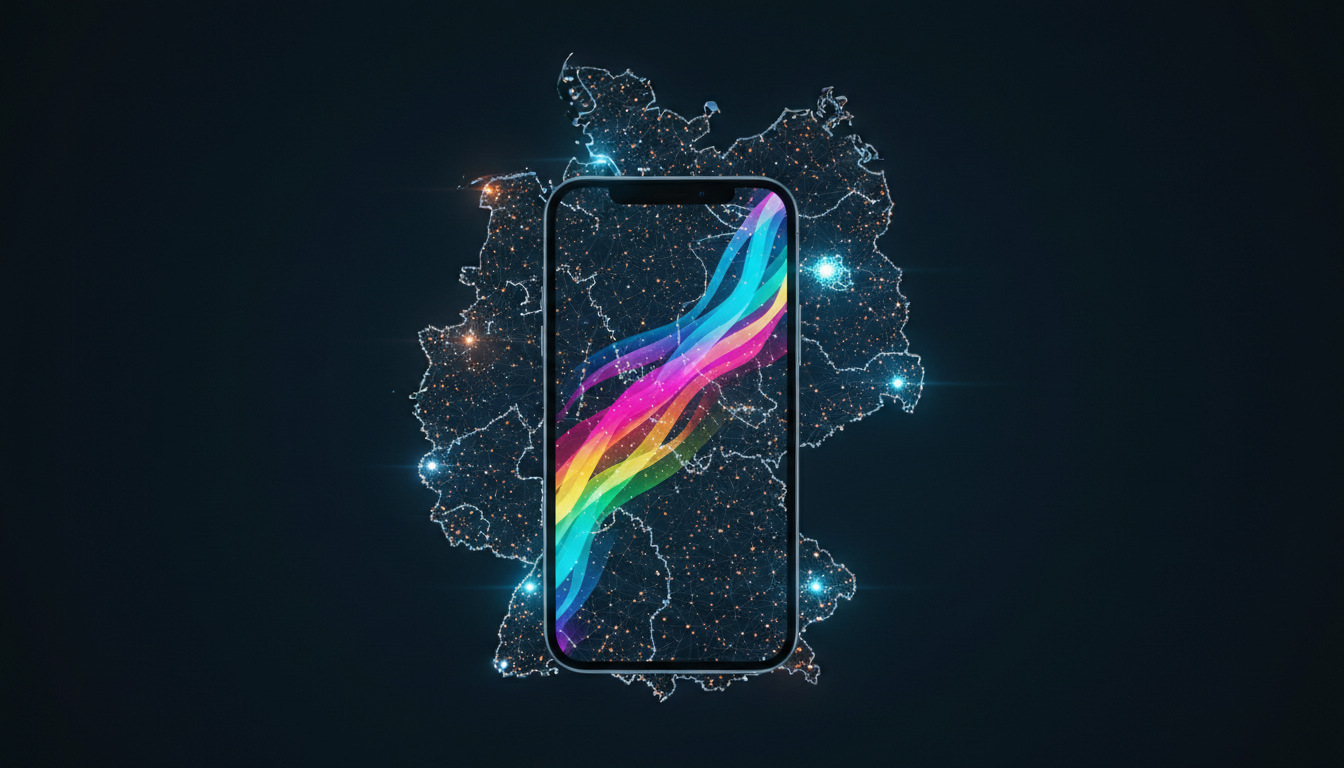
In China and the U.S., there are hundreds of micro-drama apps. In Germany? As of fall 2026, there are exactly zero established German-language micro-drama platforms with a significant user base. But that is about to change. Several startups are in the starting blocks, and the major media houses are also watching the market closely. We provide an overview of the platform landscape in Germany – who is launching, who is hesitating, and where the gaps are.
The Newcomers: Dedicated Micro-Drama Platforms
Eilin – The Community Platform from Munich
Eilin is currently the most advanced German micro-drama platform attempt. Behind the app is Vertical Minds GmbH, founded in January 2026 by Chriz Merkl (software entrepreneur), Sophie-Marie Werdin, and Markus Vogelbacher (long-standing member of the management of the Bavaria Film Group).
Status: Open beta – Eilin positions itself as the "first German-language vertical drama platform in Europe" and is already available in the Google Play Store and App Store.
Planned full launch: late summer/fall 2026.
Strategy: Eilin relies heavily on community. Users can discuss planned series and have a say in the content. The app was first publicly announced at the 2026 Berlinale.
Content strategy: The team went through a steep learning curve. Plan A – buying existing content and re-cutting it – failed due to the complexity of licensing. Plan B – adopting Asian and U.S. micro dramas – collided with quality standards. Plan C is now a mix of in-house productions and secondary exploitation of the first German micro dramas. For the beta test, Eilin is using the queer love story "Size Does Matter" by actor Kevin Silvergieter and director Dirk Rosenlöcher.
Challenge: In-house productions cost between 150,000 and 250,000 euros per series – an enormous financial burden for a startup. At launch, Eilin must be able to offer "a colorful mix from comedy to true crime" to retain users.
Badaboom – Tech and Marketing First
Badaboom is another German micro-drama app, closely linked to the production company Red Pony (a subsidiary of Saxonia Media).
Status: In development, no specific launch date communicated.
Strategy: Badaboom places a stronger focus on tech and marketing than the competition. Red Pony has already tested several series on TikTok and Instagram – including "Ghostwriter" and the AI series "Zimmermädchen." Gregor Sauter, Head of Emerging Content at Saxonia, describes the approach like this: "For us, the success of a case is not decided solely by individual organic views, but by which hypothesis we test, what we learn from it, and how a scalable business model emerges from it."
Learning: The AI series "Zimmermädchen" showed that AI-generated content does not yet resonate with the German audience. "Ghostwriter," on the other hand, achieved more than 3.4 million views across all posts on TikTok and Instagram.
Snäxx – Premium Ambitions from the Black Forest
Snäxx is the micro-drama app of the production company Black Forest Studios from Kirchzarten near Freiburg.
Status: Waitlist – the app has not yet launched publicly. Snäxx positions itself as a "vertical micro-drama streaming app: short, addictive episodes in the For You feed."
Strategy: Black Forest Studios confidently presents itself as "Europe's first micro-drama production powerhouse" and consistently focuses on premium content. With location shoots, drone footage, and detailed studio sets, the productions are visibly more elaborate than almost anything on the international micro-drama apps.
Content: The 40-part mystery series "Path of the Lost" has been shot. There are teasers for the aristocratic soap "Black Forest Royale" and "Mountain Medical," a kind of remake of the "Schwarzwaldklinik" for Gen Vertical.
Challenge: The bold bet that micro drama in Germany can skip the trash phase and establish itself directly as premium content. Whether users are willing to pay accordingly is the big question.
CandyJar – The Berliner with an International Focus
CandyJar is a micro-drama streaming app from the Berlin-based company Inkitt GmbH, founded by CEO Ali Albazaz.
Status: Live and growing – according to its own figures, CandyJar has more than 500,000 users and is available in German app stores.
Strategy: Unlike Eilin, Badaboom, and Snäxx, CandyJar targets an international audience, not specifically the German-speaking market. The content is predominantly in English. Inkitt has also launched Ironblood – a micro-drama platform for male audiences with action/adventure content that is openly communicated as AI-generated.
Special feature: Inkitt started as a platform for amateur authors and uses this data advantage: the platform's most popular stories are turned into micro dramas – a data-driven content approach with parallels to the Chinese micro-drama industry, where many series are based on successful web novels.
The Established Media Houses: Watching, but Not (Yet) Acting
RTL / RTL+
With more than 10.6 million users (November 2025), RTL+ is Germany's leading private streaming platform and relies on a subscription model. In the micro-drama space, there are no publicly known initiatives. RTL+ focuses on classic streaming content, reality formats, and live sports.
Assessment: Given its user base, production capacity, and brand awareness, RTL+ would be predestined to introduce a vertical feed or micro-drama section – similar to Netflix with "Clips" or Disney with "Verts." So far, however, there are no signs of this.
ProSiebenSat.1 / Joyn
Joyn, the streaming platform of ProSiebenSat.1, pursues a fundamentally different strategy than RTL+: free, ad-supported, aggregator. The platform reached 12.4 million viewers in November 2025 (+104% year-on-year) and integrates content from public broadcasters alongside its own channels. From Q4 2026, ZDF content will officially be available on Joyn.
In the micro-drama space, there are no known plans. However, Joyn's aggregator strategy – bundling as much content as possible under one roof – could in the future also include micro-drama content from third-party providers.
Assessment: As an ad-supported aggregator, Joyn would be a natural distribution partner for micro-drama producers. The platform could integrate micro dramas as an additional content type without having to produce them itself.
ARD / ZDF
The public broadcasters have already made first attempts in the micro-drama space. The ARD production "Between the Beats" – an elaborately produced ballet micro drama by Red Pony – was released on TikTok. The results were mixed: a start with 32,000 views, dropping to 4,500 views by the finale.
After this experience, the public broadcasters are likely to hold back. The ARD Audiothek and ZDF Mediathek are geared toward classic formats. A dedicated micro-drama strategy is not discernible.
Assessment: The public broadcasters could act as commissioners for individual micro-drama productions, but are unlikely to build their own platform or section for them.
Deutsche Telekom / MagentaTV
MagentaTV is Germany's leading TV platform with more than 180 channels and a growing streaming offering. Telekom is currently expanding its FAST channel strategy – free, ad-supported channels within MagentaTV. By summer 2026, around 40 FAST channels are to be available, including Fabella (romance/drama) and MovieDome.
In the micro-drama space, there are no known initiatives. But Telekom would be a logical partner:
- Reach: MagentaTV reaches millions of households.
- Content demand: Telekom is looking for differentiating content for its platform.
- B2B2C model: As a telecommunications provider, Telekom is a classic B2B2C partner – exactly the customer segment that micro-drama providers address.
- FAST channels: A dedicated micro-drama FAST channel would be an obvious extension.
Assessment: Telekom is unlikely to produce micro dramas itself, but could play a central role as a distribution partner or platform for third-party content.
The International Apps: Already Here, but Not in German
In parallel with the German newcomers, the major international micro-drama apps are already available in German app stores:
- ReelShort localizes the app interface and subtitles for German, but offers no German-language original content.
- DramaBox is also available in German app stores, with a similar localization strategy.
- TikTok's Pinedrama is knocking on the door of the top ten in the U.S. – a German launch is only a matter of time.
According to Omdia, 5% of all iPhone users in Germany already have a micro-drama app installed; Omdia even estimated the number of German users at 4.4 million in 2025. So the audience is there – what's missing is German-language content and a native platform.
The Dilemma: Without a Platform, No Reach
The central problem of the German micro-drama market is a classic chicken-and-egg problem:
- Without a platform, no reach – TikTok and Instagram are not optimal distribution channels for serialized content.
- Without reach, no money – advertisers and brands are waiting for proof that the format works in Germany.
- Without money, no content – in-house productions are expensive, and without content there is no reason to download a platform.
The German startups are trying to break this cycle – with different approaches:
| Platform | Approach | Differentiation |
|---|---|---|
| Eilin | Community-first | Users help shape content |
| Badaboom | Tech & marketing | Data-driven optimization |
| Snäxx | Premium content | High production value |
| CandyJar | International, data-driven | Inkitt ecosystem, AI content |
The established media houses – RTL, ProSieben, ARD/ZDF, Telekom – are watching the market but have not yet launched their own micro-drama initiatives. However, they could play a key role as distribution partners: delivering micro-drama content via RTL+, Joyn, or MagentaTV would be the fastest route to reach for specialized producers.
What's Missing: A Scalable Content Engine
What stands out when looking at the German platform landscape: all approaches struggle with the same problem – content production. In-house productions are expensive, slow, and risky. The Chinese platforms solve this problem through sheer volume: ReelShort and DramaBox each have hundreds of series in their catalogs and put new ones live almost daily.
The German market lacks a scalable content solution that can produce series quickly, cost-effectively, and in high quality – ideally in several languages and customizable for different platforms and target audiences. This is exactly where the opportunity for AI-based content production lies: whoever can cut production costs many times over while increasing speed solves the central problem of the German micro-drama market.
The German micro-drama market is at the beginning. The platforms are forming, the media houses are watching, the audience is waiting. Whoever finds the right combination of platform, content, and technology now has the chance to define a market.
Sources
- OMR: "Micro-Dramen sind das Fiction-Format der Stunde. Erreicht der Hype jetzt Deutschland?" (August 2026)
- OMR: "Micro-Drama in Deutschland: Verhelfen Brands dem Format zum Durchbruch?" (August 2026)
- XPLR: Media: "Vertical Drama: Bayerische Plattform EiLiN setzt Maßstäbe" (June 2026)
- MikroDrama.de: "Mikrodrama in Deutschland: Erste Produktionen, neue Plattformen und ein Markt am Startpunkt" (March 2026)
- Medientage Blog: "Vertical Drama: Wenn Serien hochkant gehen" (2026)
- Business Insider: "Why companies like CandyJar think micro dramas are already big in the US" (August 2026)
- Omdia: "iPhone users spend 40% more on microdramas than Android users" (July 2026)
- Omdia: "UK leads European microdrama market" (May 2026)
- DSLWEB: "Streaming Report 2026" (2026)
- DWDL.de: "Plattform-Ranking: Amazon schlägt ARD und ZDF, RTL+ klar vor Joyn" (August 2026)
- Broadband TV News: "Deutsche Telekom expands FAST line-up on MagentaTV" (April 2026)
- Storyvolt GmbH: Market Research & Competitive Analysis 2026